We are currently working on developing more in depth guides to help with the reporting procedure. For now we like to encourage everyone to view our advice and tips on creating reports, and our work in progress reporting templates that can be used to help develop a file to be sent out.
Download Links:
Advice On Report Writing: Download Here
Report Template 1.0: Download Here
Tips and Advice on Report Writing
Word to the Wise,
A criminal investigation is only as good as the report that supports it.
Reasons You Should Write Well
-You should strive to have a professional report.
-What you do and how you do it reflects on yourself and your organization.
-Well written reports lead to solid convictions.
-Well written reports assist investigators.
-Well written reports can help you get promoted.
Reports need to contain:
A beginning. A middle. An ending, not a Conclusion.
Your
report should contain only facts:
Facts are things
you saw or heard and/or can be proven.
Never put opinion in your
report.
Be clear about what you are saying.
Use the KISS
principle (Keep It Super Simple).
Be concise! Don’t try to
impress the reader with your vocabulary.
Basics of Report Writing Skills
Write in the first person.
Use chronological order.
Use past tense.
Use active voice.
Use correct spelling and punctuation.
Use correct subject/ verb agreement.
Use correct pronoun reference.
With this Comes Quality
“The best investigation is only as good as the report completed about it. A quality report is an effective report, and to qualify as effective it must be:
Complete. Clear. Concise, and Accurate.”
Missing Information
Missing information can be used to infer that you are:
Not very professional, Not Thorough, Do not have certain expertise, Not Truthful.
Write in Chronological Order and Write in Past Tense
Chronological order, is order by time. Your report should tell what happened in the order that the events took place.
Get all the facts and then list them in the order in which they happened. It is much easier to understand what happened if the details are written in chronological order, even if the people involved do not tell you the information in chronological order.
Remember everything you write in your report has already happened, so use the past tense.
Do not use the emphatic form (the word did) in combination with other action words (verbs). This form implies that something else happened.
Incorrect: Billy did say that Janie had a gun. (But later he changed his statement.)
Correct: Billy said that Janie had a gun.
Ambiguous Pronouns
When a sentence is written in such a way that the reader does not know who or what the pronoun refers to, the sentence has an ambiguous pronoun.
Each pronoun in a sentence should refer to only one antecedent.
-Incorrect: Officer Billy saw the man carrying a television set, and he began to run. Who does he refer to– Officer Billy or the man?
-Correct: Officer Billy saw the man carrying a television set, and the man began to run.
-Correct: Officer Billy saw the man carrying a television set, and he, Billy, began to run.
Report Facts, Not Opinions
–How do you know?
-You know by what you can See, Hear, Taste, Touch or Smell
–Report facts, not your opinions.
-Opinion: Epstein is a violent person.
-Fact: Epstein has been arrested twice for domestic abuse.
Be sure to cite the source of your information.
The victim entered the garage at approximately 1221 hours. (How do you know? Were you there?)
The victim said she entered the garage at approximately 1221 hours.
Use Specific Words
Accuracy involves detail, so be sure your sentences are specific enough to give the reader a clear picture. Example:
Wrong and Vague: The suspect was driving recklessly.
Correct and detailed: The suspect did not stop the vehicle before it struck the child on the sled.
Attitude Toward Reports
Reports that make it to court will be scrutinized, let make our reports useful for police to use, example:
Defense Attorney: “If it isn’t on paper, it didn’t happen.”
Defense attorneys always check to see who was the arresting officer. Every officer earns a reputation for the quality of reports that he or she writes.
Juries: “If I don’t hear it in court, it didn’t happen.”
If something is not in the report, it is harder to bring up in court. If you testify about information but it’s not in the report, credibility is lost. There is no good answer to the question, “Why isn’t it in the report?”
On the witness stand, if an officer can’t remember, but says that the information is in the report, the jury will usually believe the report.
Writing a Report
The chronological narration of the incident should outline what you did to investigate the incident.
Use headings to keep your report organized. Exact headings will depend on the type of incident that you are investigating.
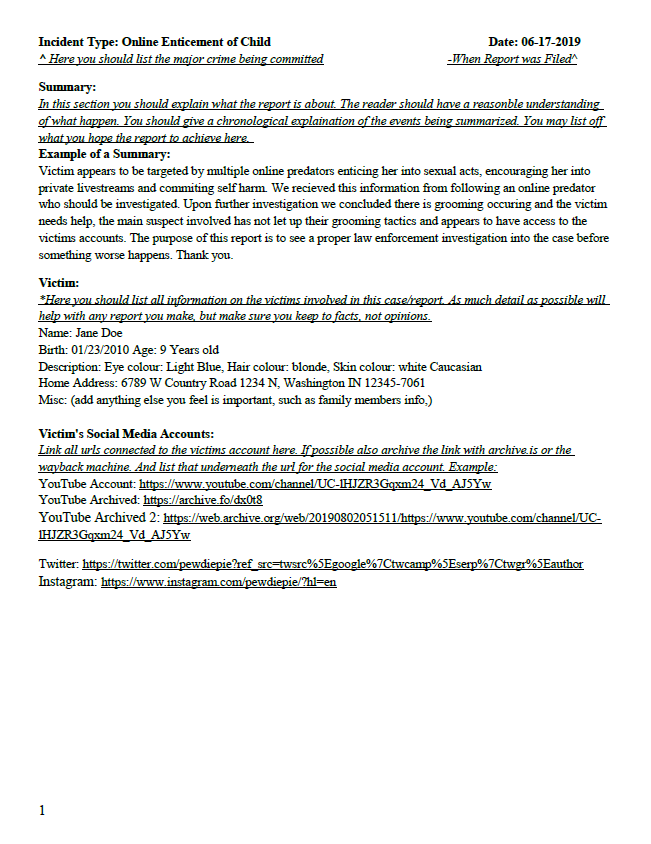
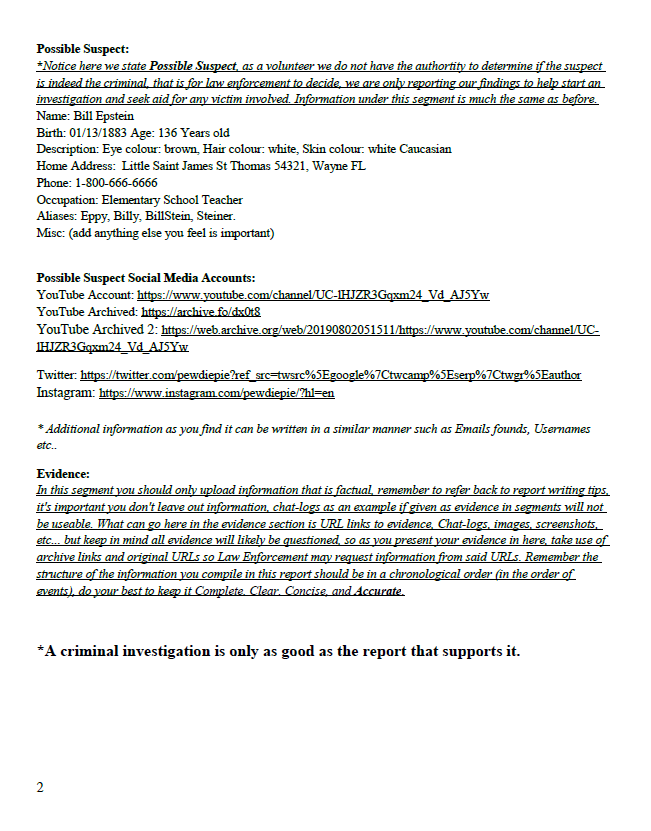
Images of our Report Template, feel free to download and use it to help with your own reporting procedure.
 Exposing Exploitation